

Redundant Fiber Path
Fiber optic communication systems often run into situations where higher reliability is required. For some types of applications such as Public Safety, often a secondary fiber path adds reliability and redundancy to the system. Optical Zonu provides solutions for redundant fiber path applications for all 3rd party fiber optic communications systems and equipment. This technology is compatible with dual fiber, WDM, CWDM, and DWDM based communications systems. The system acts as a ‘black box’ providing a single bi-directional fiber input and output. In between the two locations, two distinct fiber paths can be run. Only a single fiber path is active at any given time. If the primary fiber is ever cut or disconnected, the system will automatically switch to the redundant path.

The equipment is available in either rackmount or wall mount form factors. Management is available but not required for proper operation of the equipment. If management is not employed; the system can function independently, automatically recovering from a primary path fiber failure. If management is used; the system can be fully monitored remotely via Ethernet networking. Alarms are available via Restful API or SNMP. The system is also compatible with CloudView NMS for more advanced Network Monitoring Systems.

The redundant link can be created using 3RU rackmount chassis known as the J3U platform or with single slot J3U card enclosures. Any combination of chassis or card enclosures can be used to accomplish this link. For network management, the Optical Zonu J-S14 card must also be ordered with the system. For the rackmount chassis, redundant power supply options are available in either AC or -48V DC power input.
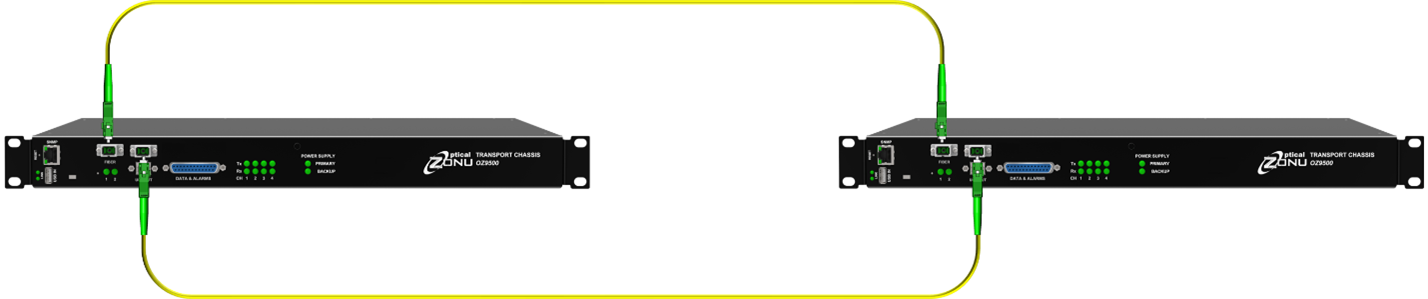
This Optical switch technology is also available in other products, such as the OZ9000 type transport chassis. Optical Zonu equipment can be ordered with redundant path technology built in, offering two fiber ports. The primary port will carry all optical communications until the path is not available, and then an optical switch will change the path to the secondary fiber. In addition to diversity fiber path options, equipment can also be ordered with OTDR technology that can identify the distance to a fiber fault. This allows rapid recovery in the event of a failure; while the secondary path maintains service until the primary path is repaired.